

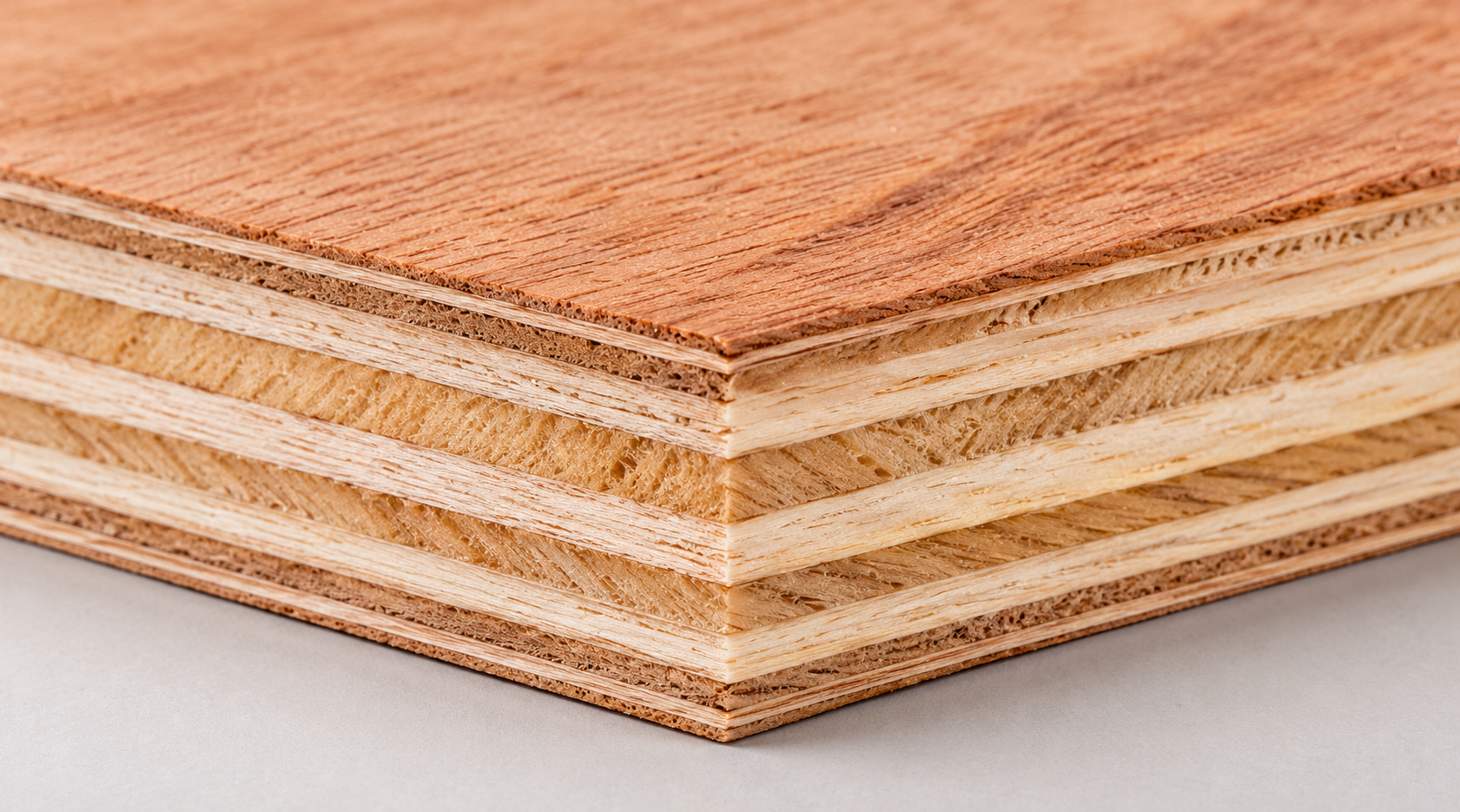
Core Veneer vs Face Veneer ,Differences, Grades and Uses for Plywood and Furniture Buyers
Core veneer carries the strength and the cost. Face veneer carries the look and the grade. Here is how to tell them apart, how each is graded, and which one to specify for your product.
Covers a 12-factor comparison, face and core grades, thickness and cut, species, 10 applications, defects, an ordering checklist and 8 FAQs.
| Quick answer:
Core veneer is the inner layer of plywood. It is rotary-peeled, graded for strength and glue-line quality, and appearance does not matter. Face veneer is the visible outer layer. It is graded for colour, grain and freedom from defects, and is peeled or sliced thinner. Specify core veneer by thickness, moisture, sheet size and defect limits. Specify face veneer by species, cut, grade and thickness. Mixing the two up is the most common cause of rejected veneer lots. MaasiUniverse supplies Eucalyptus core veneer and face veneer from our factory in Thailand to plywood and furniture makers in India and worldwide. Email connect@maasiuniverse.com. |
1. What Core Veneer and Face Veneer Actually Are
Plywood is built from thin layers of wood, called plies, glued with the grain of each layer at right angles to the next. That cross-layering is what gives plywood its stability. The layers do not all do the same job.
Core veneer
Core veneer forms the inside of the board. Its job is structural: it provides bulk, bonding area and strength. Buyers care about thickness consistency, flat sheets, moisture content and how well it glues. Small knots or colour variation are usually acceptable because nobody sees them.
Face veneer
Face veneer forms the outer layers. Its job is appearance and surface quality. It must take paint, polish or lamination well and look consistent. It is graded on grain, colour, knots, splits and patches, and it is usually thinner and costs more per square metre than core.
| Common mistake:
Buying “veneer” without saying core or face. The two products differ in thickness, grade, species choice and price. A quote that does not state which one is being priced cannot be compared with another quote. |
2. Core Veneer vs Face Veneer — 12-Factor Comparison
Every factor that matters when you write a purchase specification. The grade, thickness and defect rows are where most disputes start.
| Factor | Core Veneer | Face Veneer |
| Position in plywood | Inner layers | Outer layers, visible surface |
| Main job | Strength, bulk, glue bonding | Appearance, surface quality |
| Typical cut | Rotary peeled | Rotary peeled or sliced (flat, quarter, rift) |
| Typical thickness | About 1.0–2.5 mm | About 0.3–0.6 mm sliced; about 0.5–1.5 mm rotary |
| Species used | Fast-growing hardwoods such as Eucalyptus; some softwoods | Chosen for look: hardwoods and decorative species |
| Grading basis | Strength, flatness, defect limits | Colour, grain, knots, splits, patches |
| Knots and colour variation | Usually acceptable within limits | Restricted or not allowed in higher grades |
| Moisture control | Critical for gluing | Critical for gluing and flatness |
| Price per m² | Lower | Higher, rises steeply with grade |
| Waste and recovery | Higher recovery from the log | Lower recovery; selection and matching needed |
| Buyer focus | Consistency and volume | Look, matching and grade |
| Typical buyers | Plywood and blockboard mills | Plywood faces, furniture and door makers |
Thickness ranges are typical industry ranges. Confirm your exact press schedule and board construction with us before ordering.
| Fast fact:
Because core veneer makes up most of the board by volume, a small saving per sheet on core adds up faster than the same saving on face. Face veneer drives the visible quality and the price tier of the finished board. |
3. Veneer Grades — How Face and Core Are Graded
Grade names differ between mills, countries and standards, so always define the grade in writing. The table below shows common ways face veneer is described. Treat it as a guide to the language, not as a universal rule.
Face veneer grades
| Grade level | What it usually means | Typical use |
| Premium / A | Clean, matched, few or no visible defects | Furniture exteriors, visible panels, decorative boards |
| Good / B | Minor, small defects; mostly sound surface | Cabinet faces, doors, laminated boards |
| Sound / C | Small knots and patches allowed | Furniture parts that get painted or laminated |
| Utility / D | Larger defects and repairs allowed | Non-visible or heavily covered surfaces |
| Backing | Used on the reverse face | Back panels, balancing layer |
Related references: ANSI/HPVA HP-1 (hardwood plywood face grades), EN 635 (plywood face classification) and ISO 2426 (classification by surface appearance). Verify the current edition before quoting any standard to a customer.
Core veneer grades
Core grading is more practical than visual. Mills usually grade core on how many defects are allowed, whether sheets are full size or composed from pieces, and how flat and consistent the thickness is.
| Core grading point | What to specify |
| Sheet size | Length and width with tolerance; full sheets or composed (jointed) sheets |
| Thickness tolerance | Nominal thickness and allowed variation across the sheet |
| Knots and holes | Maximum size and number allowed; whether holes must be patched |
| Splits and cracks | Maximum length; no through-splits above agreed limit |
| Overlap and gaps | Allowed width of overlap or gap in composed sheets |
| Moisture content | Target range at dispatch, usually checked with a meter |
| Flatness | No heavy waviness or buckling that will cause press problems |
| The one thing to know:
A face veneer grade name is only useful if both sides agree what it allows. Send a physical sample or photo reference with the specification. It prevents most grade disputes. |
4. Thickness and Cut — Rotary, Sliced and Why It Matters
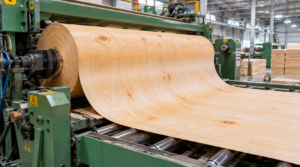
How the log is cut decides the look of the veneer and its thickness. Core veneer is almost always rotary peeled because it is the fastest and most economical method.
| Cut method | How it is made | Result | Used for |
| Rotary peeled | Log is rotated against a knife and peeled like a roll of paper | Wide sheets, wild or cathedral grain | Core veneer, plywood faces, packing |
| Flat / plain sliced | Log half is sliced across the grain | Cathedral pattern, consistent figure | Decorative face veneer |
| Quarter sliced | Cut radially from the log | Straight, even grain; some flake figure | Premium furniture and panels |
| Rift cut | Cut at an angle to the growth rings | Fine straight grain, no flake | Specialist furniture and architectural use |
Thicker core veneer gives more strength per layer and uses fewer plies, but it needs more glue and is harder to dry flat. Thinner face veneer is easier to match and saves expensive wood, but it can show glue bleed-through or sanding-through if it is too thin.
5. Species — Hardwood and Softwood, Core and Face
Species selection affects strength, weight, finish and price. Fast-growing plantation hardwoods are widely used for core because they peel well and glue consistently. Face species are chosen for appearance.
| Species type | Typical role | Why buyers choose it |
| Eucalyptus (plantation hardwood) | Core veneer; also a face base under decorative layers | Fast-growing, hard, good strength and consistent peel |
| Other plantation hardwoods | Core and face | Availability and cost balance |
| Decorative hardwoods | Face veneer | Visible grain, colour and finish |
| Softwoods | Core and lower-cost faces | Lighter weight, lower cost, easier handling |
Species, density and availability vary by season and supply. Confirm current options with us before specifying.
6. Where Each Veneer Is Used — 10 Applications
| Application | Core veneer | Face veneer | Notes |
| Commercial plywood | Yes — inner plies | Yes — outer plies | Grade driven by end use |
| Furniture-grade plywood | Yes | Yes — higher grade | Finish quality matters |
| Blockboard / flush door | Yes — cross bands | Yes — faces | Check door skin thickness |
| Laminated panels | Yes | Yes — substrate face | Face must be sandable and flat |
| Decorative wall panels | Sometimes | Yes — decorative cuts | Matching and colour consistency |
| Kitchen and wardrobe boards | Yes | Yes | Often laminated over the face |
| Packing and crates | Yes | Rarely | Cost and strength driven |
| Pallets and containers | Yes | No | Strength and moisture |
| Export plywood | Yes | Yes | Buyer standards and moisture checks |
| Veneered furniture | No | Yes — thin sliced | Thickness and matching critical |
7. Veneer Quality and Defects — What Is Acceptable Where
Not every defect is a reject. The same defect can be fine in core and unacceptable in a premium face. Agree the limits before dispatch.
| Defect | What it is | Core veneer | Face veneer |
| Knots | Branch bases in the wood | Small, sound knots usually OK | Restricted; none in premium grades |
| Splits and cracks | Separation along the grain | Limited length allowed | Little or none in higher grades |
| Overlap / gap | Pieces overlapping or leaving a gap in joined sheets | Allowed within width limit | Not accepted in matched faces |
| Stain and discolouration | Blue stain, mineral streaks, uneven colour | Often acceptable | Grade-limiting |
| Wavy or buckled sheets | Uneven drying or thickness | Causes press problems; limit it | Causes surface telegraphing |
| Thickness variation | Uneven peel across the sheet | Tight tolerance needed | Critical for sanding and finish |
| High moisture | Wet veneer | Weak glue bond, blisters, delamination | Same plus warping |
| Common mistake:
Skipping a moisture check at receiving. Wet veneer causes poor glue bonding, blisters and delamination later in the plywood press. Veneer is commonly dried to roughly 8–12% before gluing. Confirm the range your press needs and test incoming lots. |
8. How to Order Veneer — Six Things to Specify
- Core or face. State which one, and which layer it is for.
- Species. Name the species. “Hardwood” is not a specification.
- Thickness and tolerance. Nominal thickness plus allowed variation.
- Size. Length and width, and whether full sheets or composed sheets.
- Grade and defect limits. Write the limits, and attach a sample or photo reference.
- Moisture and packing. Target moisture range, bundle size, wrapping and the loading plan.
| MaasiUniverse:
We supply Eucalyptus core veneer and face veneer from our factory in Sai Noi, Nonthaburi, Thailand. [Confirm: available sizes, thicknesses and monthly capacity.] Samples available on request. Export supply to India, Vietnam and other markets. Email: connect@maasiuniverse.com | |
| Request Veneer Samples and a Quotation — Core and Face, Specified to Your Press Schedule:
-> Request a Quote: maasiuniverse.com/contact -> Email: connect@maasiuniverse.com
|

9. Frequently Asked Questions — 8 Questions Buyers Ask Most
[ WordPress: Use Rank Math FAQ Block for each Q&A — not regular paragraph blocks. ]
| Question | Answer |
| What is the difference between core veneer and face veneer? | Core veneer forms the inner layers and is graded for strength and gluing. Face veneer forms the visible outer layers and is graded for appearance. |
| Is core veneer cheaper than face veneer? | Generally yes. Core veneer is thicker, has looser defect limits and higher log recovery. Face veneer costs more and rises with grade. |
| What thickness is core veneer? | Typically about 1.0 to 2.5 mm depending on the board. Confirm the exact thickness with your press schedule. |
| What thickness is face veneer? | Sliced face veneer is commonly about 0.3 to 0.6 mm. Rotary face veneer is thicker, around 0.5 to 1.5 mm. |
| Can core veneer be used as face veneer? | Only for low-grade or covered surfaces. Core veneer is not graded for appearance and may show knots, colour variation and patches. |
| What moisture content should veneer have? | Veneer is commonly dried to roughly 8–12% before gluing. Confirm the range your press and adhesive need. |
| Which species is best for core veneer? | Fast-growing plantation hardwoods such as Eucalyptus are widely used because they peel well and glue consistently. |
| How do I avoid grade disputes? | Write the grade and defect limits, attach a sample or photo reference, and agree an inspection method before dispatch. |
| Bottom line:
Core veneer and face veneer do different jobs, so they are graded, priced and specified differently. Core is bought for strength and consistency. Face is bought for appearance and grade. Three things to confirm before any order: whether it is core or face, the thickness and moisture limits, and written defect limits with a sample. MaasiUniverse supplies both from Thailand to plywood and furniture makers in India and worldwide. |
Related Guides:
-> Face veneer grades explained for plywood and furniture makers
-> Veneer thickness guide — core and face veneer for plywood
-> Hardwood vs softwood veneer — which is right for your plywood?
-> Wholesale veneer suppliers in India — how to source in bulk
[ Internal links above use planned slugs. Replace each with the live URL once the matching blog is published. ]
About the Author
Mr. Prakrit has 15 years in veneer manufacturing and supply to plywood, furniture and door makers in India, Vietnam, Thailand and global markets.