

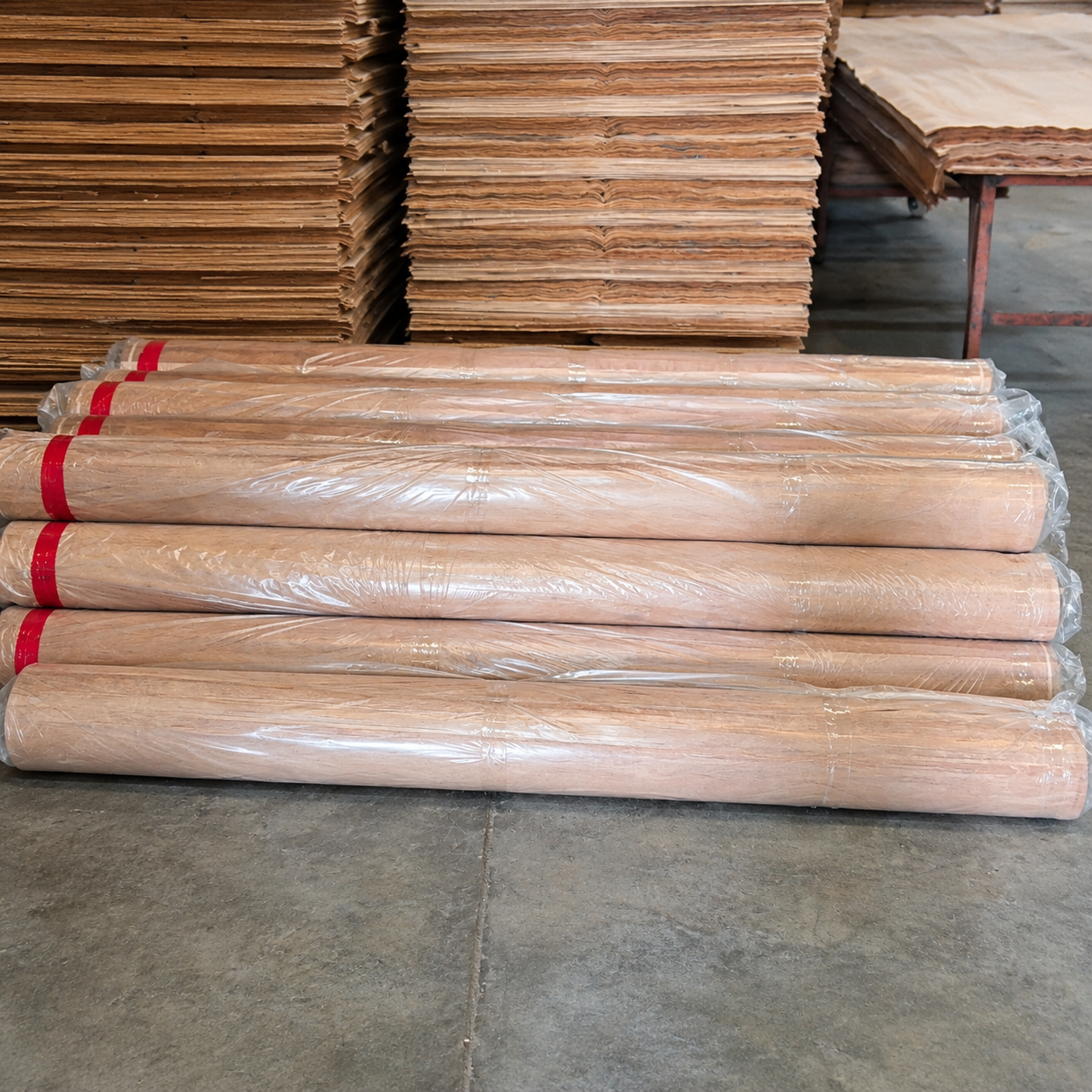
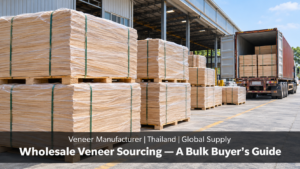
Wholesale Veneer Sourcing — How to Buy Core and Face Veneer in Bulk
Bulk veneer buying fails on consistency, moisture and paperwork, not on price. Here is how to compare suppliers, write a specification, and inspect a lot before it reaches your press.
Covers local vs imported supply, a 10-point supplier checklist, an RFQ specification sheet, pricing factors, import logistics, inspection, red flags and 8 FAQs.
| Quick answer:
To source veneer in bulk, send every supplier the same written specification: species, core or face, thickness and tolerance, sheet size, grade with defect limits, moisture range and packing. Then compare landed cost, not ex-factory price, and test a sample lot before the first full order. Choose by consistency first. A slightly cheaper veneer that varies in thickness or moisture costs more in press rejects, rework and delamination than it saves. MaasiUniverse supplies Eucalyptus core veneer and face veneer from Sai Noi, Nonthaburi, Thailand to plywood and furniture makers worldwide. Email connect@maasiuniverse.com. |
1. Why Bulk Veneer Buying Is Different
A plywood mill does not buy veneer once. It buys it every week, in volume, for a press that cannot run on bad feedstock. That changes what matters when you choose a wholesale veneer supplier.
- Consistency over a season. The first container may be perfect. What you need is the fortieth container to match it.
- Moisture at arrival. Veneer that leaves dry can arrive wet if packing, transit or storage is poor.
- Paperwork and timing. A press schedule stops when a lot is stuck at customs or documents are wrong.
- Spec discipline. Without a written specification, every dispute becomes one person’s word against another’s.
| Common mistake:
Comparing suppliers on price per sheet or per cubic metre alone. Sheets of different thickness, grade or moisture are not the same product, and the lowest quote is often the one that left something out. |
2. Local vs Imported Veneer — What Changes
Most mills buy from both sources at different times. Neither is always better. The table shows what to weigh.
| Factor | Local supply | Imported supply (for example from Thailand) |
| Lead time | Shorter; often available from stock | Longer; plan around production, shipping and clearance |
| Species availability | Depends on regional plantation supply | Access to species and volumes not available locally |
| Price comparison | Ex-works or delivered quote | Compare landed cost: product, freight, insurance, duty, clearance |
| Consistency | Varies widely by mill | Factory-controlled lots can be very consistent; confirm with samples |
| Payment terms | Usually credit or advance | Often LC, TT advance or balance against documents |
| Paperwork | Invoice and transport documents | Commercial invoice, packing list, bill of lading, origin and plant documents |
| Supply risk | Seasonal and regional | Shipping, port and currency risk |
| Best for | Fast top-up and local relationships | Planned volume and consistent specification |
Import duty, documentation and plant-health requirements change. Confirm current rules with your customs broker or the customs authority of your country before ordering.
| Fast fact:
Many mills use both: imported veneer for the planned base volume and local veneer to cover gaps. The key is that both are bought to the same written specification. |

3. Supplier Checklist — 10 Questions Before You Send an RFQ
Ask these before you compare price. A supplier who answers them clearly, in writing, is easier to work with once the order is running.
| # | Question | What a good answer looks like |
| 1 | Do you manufacture the veneer or trade it? | Names the factory, location and processes |
| 2 | Which species and cuts do you supply? | Lists species and states rotary or sliced for each |
| 3 | What thickness range and tolerance can you hold? | Gives a range and a stated tolerance, not just “as required” |
| 4 | What sheet sizes are standard? | Lists sizes and says whether sheets are full or composed |
| 5 | How do you grade core and face? | Provides written grade definitions and photo references |
| 6 | What moisture range do you ship at, and how is it checked? | States a range, the method and the records kept |
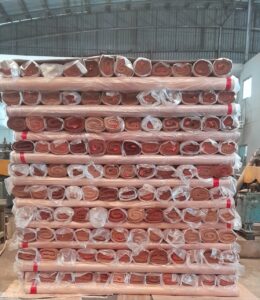
| 7 | How is veneer packed for transit? | Describes bundling, wrapping, strapping and container loading |
| 8 | What monthly volume can you supply consistently? | Gives a capacity figure and typical order sizes |
| 9 | Can you supply a sample lot from current production? | Yes, with the batch identified |
| 10 | What documents come with each shipment? | Lists invoice, packing list, bill of lading and any required certificates |
| The one thing to know:
Ask for a sample from current production, not a showpiece sheet. The sample should come from the same lot type you will receive, with the batch identified, so you can compare the first shipment against it. |
4. The Specification Sheet to Send With Every RFQ
One page, same for every supplier. It is also your contract reference if a lot is disputed.
| Specification item | What to write |
| Product | Core veneer or face veneer; which layer it is for |
| Species | Named species, not just “hardwood” |
| Cut | Rotary peeled, flat sliced, quarter sliced or rift |
| Thickness | Nominal thickness and allowed tolerance |
| Sheet size | Length x width with tolerance; full or composed sheets |
| Grade | Grade name plus written defect limits and a photo or sample reference |
| Defect limits | Knots, splits, overlaps, gaps, stain, wave |
| Moisture content | Target range at dispatch and method of measurement |
| Packing | Bundle size, wrapping, strapping, pallets or loose, container loading |
| Quantity and schedule | Total volume and shipment frequency |
| Delivery terms | Incoterm, port of loading and port of discharge |
| Inspection | Who inspects, when, and what happens to a failed lot |
MaasiUniverse can supply a blank specification template with your first RFQ. [Confirm before publishing.]
5. What a Veneer Quote Should Show — and What Drives Price
A good quote makes comparison easy. A vague one hides the differences. These are the factors that move the price of core and face veneer.
| Price factor | Why it matters | What to check on the quote |
| Species | Raw material cost and availability differ | Species named on the quote line |
| Cut and thickness | Thinner sliced faces cost more per area to produce | Cut and thickness stated per line |
| Grade | Face grade is the biggest price driver | Grade definition attached or referenced |
| Moisture | Drying adds cost and affects quality | Moisture range written |
| Sheet size | Larger, full sheets command a premium | Size and full vs composed stated |
| Order volume | Volume lowers unit cost and stabilises supply | Price breaks by quantity |
| Packing | Export packing adds cost and protects quality | Packing described and included or separate |
| Delivery terms | Incoterm decides who pays freight and risk | Incoterm and port stated |
| Common mistake:
Accepting a quote with no grade definition. “Grade A” from one mill can look different from “Grade A” from another. Always attach the definition. |
6. Import Logistics — Incoterms, Containers and Documents
If you import veneer, the delivery term decides who carries the cost and the risk at each step.
| Term | What it means in practice | Best when |
| FOB (port of loading) | Seller delivers on board; buyer arranges and pays main freight | You have a freight forwarder and want control of shipping |
| CFR / CIF (destination port) | Seller pays freight to your destination port; CIF includes insurance | You want a simpler landed-cost comparison |
| EXW (factory) | Buyer collects at the factory and handles export clearance | Rarely used for overseas veneer; the buyer carries most steps |
Typical documents include the commercial invoice, packing list, bill of lading and certificate of origin. Wood and veneer shipments may also need a plant-health or fumigation certificate, and wooden packing material must meet ISPM 15 treatment rules. Confirm the exact list with your customs broker.
| Fast fact:
Ask the supplier how bundles are loaded into the container. Poor stacking and bracing cause edge damage and moisture pick-up in transit, and those are the most common causes of transit claims. |
7. Inspecting a Lot Before It Reaches the Press
Check every incoming lot against the specification. Record the results. Do this before the veneer goes into the dryer or the press line.
| Check | How | Action if it fails |
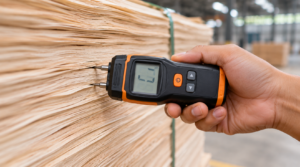
| Moisture content | Meter reading on a sample of bundles, top, middle and bottom | Hold the lot, notify the supplier, re-dry if agreed |
| Thickness | Measure across several sheets and positions | Compare to tolerance; claim if outside |
| Sheet size | Measure length and width on a sample | Reject sheets outside tolerance |
| Defects and grade | Compare against the sample and written defect limits | Separate and photograph non-conforming sheets |
| Flatness and damage | Visual check for wave, buckling, edge damage and mould | Record and photograph before unloading further |
| Packing and count | Compare bundles to the packing list | Note shortages on the delivery receipt |
Agree a sampling plan with your supplier in writing, for example an AQL-based plan, so that a failed lot is defined the same way by both sides.
8. Red Flags — and a Six-Step Order Process
Red flags when choosing a veneer supplier
| Red flag | Why it matters |
| No named factory or address | You cannot audit or trace the product |
| No written grade definitions | Disputes are unavoidable |
| Will not send a sample from current production | The sample may not match the shipment |
| Quote is far below the others | Specification is probably lower, or something is excluded |
| Vague moisture and thickness answers | Quality control is likely informal |
| Pressure to pay in full with no documents | Risk sits entirely with you |
Six-step order process
- 1. Specification. Send the one-page specification to shortlisted suppliers.
- 2. Quotes. Compare landed cost and written terms, not headline price.
- 3. Sample. Request a sample from current production and test it on your line.
- 4. Trial order. Place a smaller first order to confirm consistency and documents.
- 5. Scheduled supply. Agree volume, schedule and price terms for regular orders.
- 6. Review. Track rejects, moisture readings and delivery performance each quarter.
| MaasiUniverse:
We supply Eucalyptus core veneer and face veneer from our factory in Sai Noi, Nonthaburi, Thailand. [Confirm: available sizes, thicknesses, monthly capacity and standard packing.] Samples available on request. Export supply to plywood and furniture makers worldwide. Email: connect@maasiuniverse.com | |
| Request Veneer Samples and a Quotation — Written Specification, Landed Cost, Documents Listed:
-> Request a Quote: maasiuniverse.com/contact [confirm URL] -> Email: connect@maasiuniverse.com
|
9. Frequently Asked Questions — 8 Questions Buyers Ask Most
[ WordPress: Use Rank Math FAQ Block for each Q&A — not regular paragraph blocks. ]
| Question | Answer |
| How do I find a reliable wholesale veneer supplier? | Shortlist suppliers who name their factory, send a written grade definition and a sample from current production, and quote against your specification. |
| Should I buy local or imported veneer? | Many mills use both. Local supply covers speed; imported supply covers planned volume and consistency. Compare landed cost, not ex-factory price. |
| What should a veneer RFQ include? | Product (core or face), species, cut, thickness and tolerance, sheet size, grade and defect limits, moisture range, packing, quantity and delivery terms. |
| What is landed cost? | The total cost delivered to your mill: product price plus freight, insurance, duty, clearance and local transport. |
| What moisture should bulk veneer arrive at? | Agree a range in writing. Veneer is commonly dried to roughly 8–12% before gluing, but your press and adhesive set the right target. |
| What documents come with an imported veneer shipment? | Typically a commercial invoice, packing list and bill of lading, with origin and plant-health documents where required. Confirm with your broker. |
| How do I test a supplier before a large order? | Request a sample from current production, run it on your line, then place a smaller trial order before committing to scheduled volume. |
| Where does MaasiUniverse supply veneer? | We supply Eucalyptus core veneer and face veneer from Thailand to plywood and furniture makers worldwide. Email connect@maasiuniverse.com for samples and a quotation. |
| Bottom line:
Bulk veneer sourcing is won on specification and inspection, not on the cheapest quote. Write the specification once, send it to every supplier, and compare landed cost. Three things to do before the first order: get a sample from current production, attach written grade and moisture limits, and agree the documents and inspection method. MaasiUniverse supplies core and face veneer from Thailand to plywood and furniture makers worldwide. |
Related Guides:
-> Core veneer vs face veneer — differences, grades and uses
-> Veneer pricing factors — what affects core and face veneer cost
-> Veneer quality and defects — knots, splits, moisture and overlaps
-> Importing veneer — a sourcing checklist for plywood makers